Ass24x7
Sales IQ Plus Online
Sales IQ Plus Online
Couldn't load pickup availability
The Sales IQ Plus assessment is an objective analysis designed as a starting point — a type of ‘personalized map’ for your sales knowledge at this moment in time. It tells you where you are, why you are there and how to improve by offering specific insights and responses based on your assessment results.
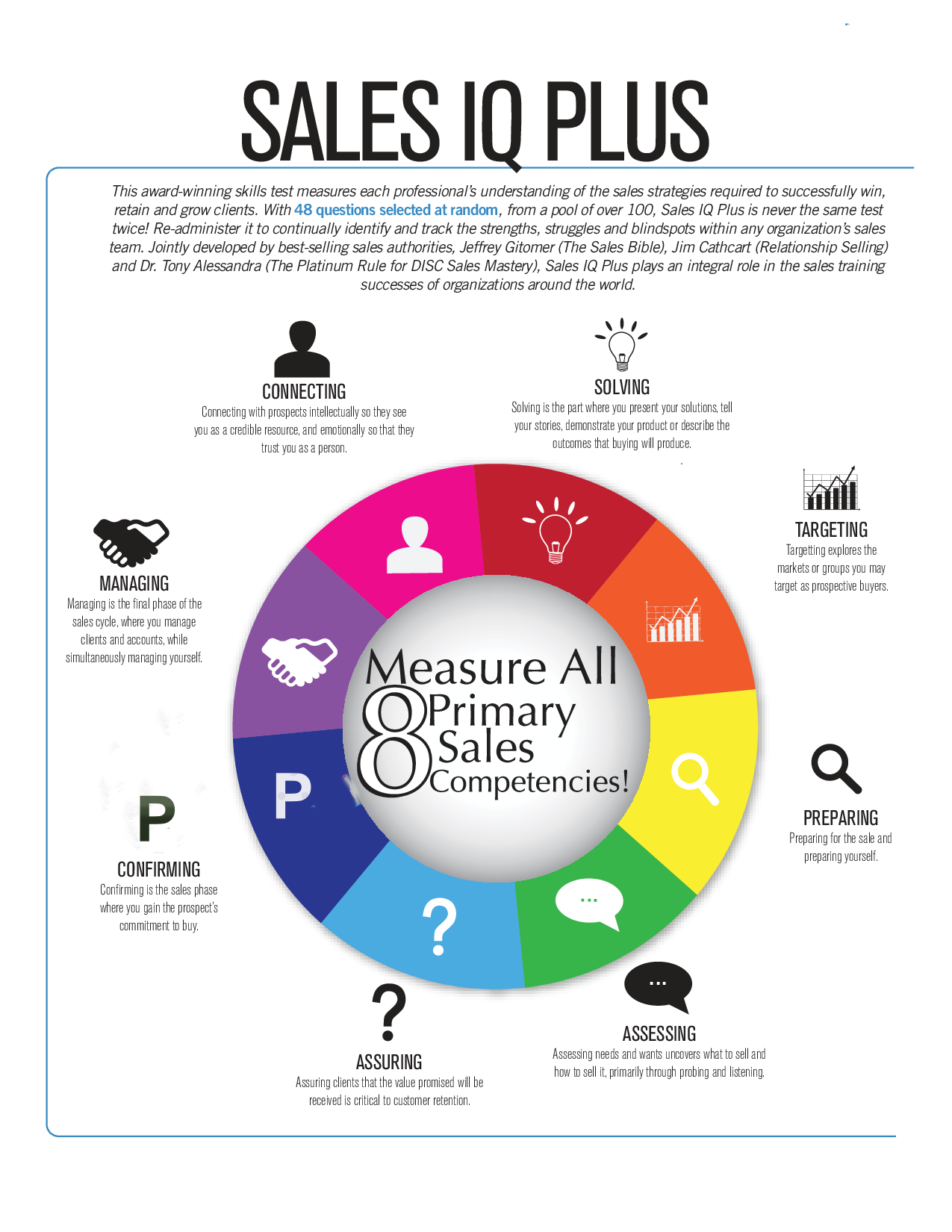
This assessment takes approximately 30 minutes to complete and consists of 48 questions that guide you in assessing each of the eight primary sales competencies. From this, you will be able to accurately and more easily:
- Develop a plan to overcome challenges
- Simplify sales training
- Focus on areas that produce results
- Build confidence
- Determine strategies that are needed to sell a specific product/service in a given market
- Identify every new sales applicant’s strengths and weaknesses
- Address specific training or management needs of a salesperson or sales team
How We Measure Your Sales IQ
The eight steps below represent, from our experience, the most critical stages of successful selling. The 48 Sales IQ questions are randomly generated from 100+ questions that explore best practices in each area. This Sales IQ is not a statement of potential, but rather a measure of approach to, and understanding of, selling in today’s professional, competitive environment. Many of the traits that would assure sales success are the eight stages and their brief descriptions.
1. Preparing covers how you prepare for the sale and prepare yourself. You can be well prepared with information and sales tools but if you are not in the appropriate frame of mind, or if you do not appear professional to the buyer, you might not get the sale.
2. In Targeting, we explore the markets or groups you may target as prospects. Then we focus on the individuals with whom you will make contact. This includes the sales strategies and tactics you select for each target. Poor targeting with great selling would result in limited success because you would be selling to the wrong people.
3. Connecting is the initial contact step in selling where you must appeal to people intellectually so that they see you as a credible resource and emotionally so that they trust you as a person. Without either, you are inhibited from learning enough about them to solve their problems and make a sale.
4. Assessing needs and wants uncovers what to sell and how to sell it primarily through probing and listening. As they say, “In sales as in medicine, prescription before diagnosis is malpractice.”
5. Solving the buyer’s problem, or filling their need, is where most of the sales attention has been placed in the past. This is the part where you present your solutions, tell your stories, show your product or describe the outcomes that buying will produce. At its lowest level, this is a sales pitch. At its highest level, this is a dialogue where you prove there is great value to them in buying from you.
6. Once you have shown that you can solve their problem, it is time to gain their commitment to buy. This is the Confirming phase. Your goal is to confirm the commitment to purchase. Historically, this has been known as “closing” the sale, but the truth is that it is not an end but the initiation of your sales relationship, the beginning to serve the customer as they begin to pay you for the value they receive.
7. A confirmed sale needs Assuring that the value promised will be received. This is where relationships are built and customer loyalty is to be given (by you) more than expected (from them.)
8. Managing is the final phase of the sales cycle where you manage sales and accounts and self-management of yourself. Ultimately, we are all our own ‘sales manager’. This is the phase of selling where you must get yourself to do what needs to be done even when you do not feel like doing it.
Share